
Daily Trade News · August 26, 2026
Canada Sets 15%, 25% and 50% Counter-Tariffs for September 8
Canada published the tariff-item list for new duties on $27.6 billion of U.S. goods. The same reporting window also brought a future AES rejection rule for BIS license filings and a new Section 337 complaint involving wearable breast pumps.
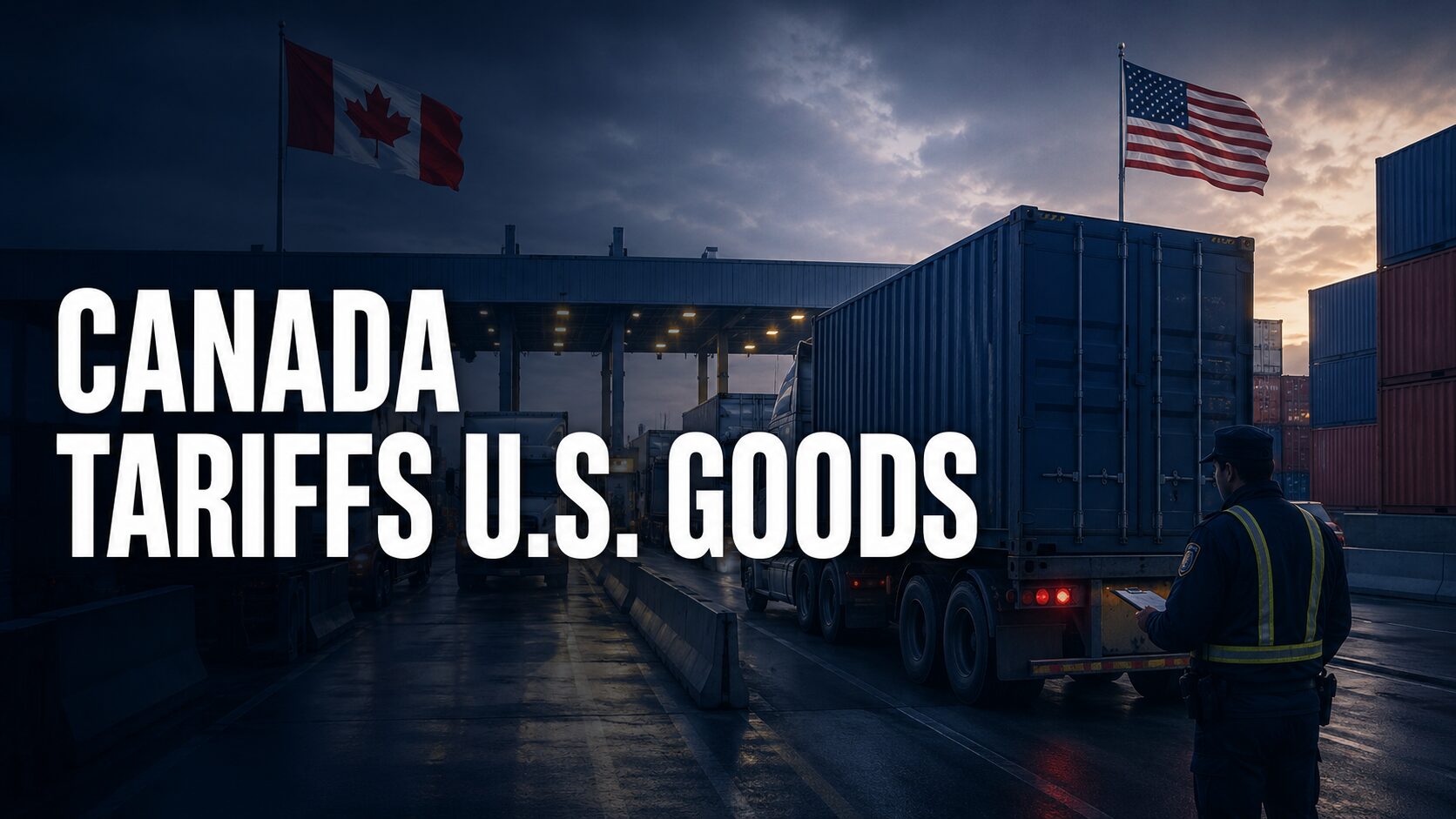
Canada’s Department of Finance says the new counter-tariffs will take effect at 12:01 a.m. on September 8, 2026. Rates vary by Canadian tariff item, and the measure includes a specific exception for qualifying U.S. goods already in transit to Canada when the tariffs begin.
Canada publishes the product list for its September 8 counter-tariffs
On August 25, the Government of Canada announced matching countermeasures in response to U.S. tariffs that took effect on August 22. Canada says its new duties will cover $27.6 billion in imports from the United States and will use rates of 15%, 25% or 50%, depending on the Canadian tariff item. The targeted sectors include steel and aluminum, dairy, appliances, agricultural equipment, pulp and paper, plastics, and electronics. Read the August 25 Department of Finance Canada announcement.
The measure is tariff-item specific. Canada’s published list shows, for example, a 15% rate for certain fork-lift trucks, industrial robots and machinery; 25% for many fish, dairy and appliance lines; and 50% for many steel, aluminum, apparel and furniture lines. A product description alone is not enough to determine liability—the Canadian tariff item and origin rule must both be checked. Search Canada’s official tariff-item list.
The White House issued a response on August 25 describing Canada’s countermeasures and restating the Administration’s position. That release is policy messaging; it is not a new Presidential Proclamation, Executive Order or CBP filing instruction. Read the August 25 White House release.
CBP will make BIS license-tolerance response code 802 fatal in AES
CBP issued CSMS #69647661 at 3:04 p.m. EDT on August 25. At the request of the Bureau of Industry and Security, CBP will change AESTIR Commodity Response Code 802 from “Verify” to “Fatal” on September 25, 2026. After that change, an Electronic Export Information filing that triggers response 802 will be rejected and must be corrected before AES accepts it. Read CBP CSMS #69647661.
Response 802 applies when an EEI includes a BIS license claim and the reported license value exceeds 110% of the BIS license value. CBP notes that the tolerance may have been exceeded by an earlier transaction or by the current filing and that the license has been decremented. Filers should compare the CL1 license value, CL2 license number or authorization citation, the corresponding X12 elements, prior shipments, and the BIS license record before resubmitting. Open the ACE AESTIR Appendix A documentation.
USITC seeks comments on a wearable breast-pump Section 337 complaint
The U.S. International Trade Commission published a notice on August 25 concerning a complaint titled Certain Wearable Breast Pumps, Associated Milk Storage Containers, and Components Thereof, Docket No. 3932. The complaint was filed on August 20 by Willow Innovations, Inc. and Willow Blossom HoldCo Ltd. and names companies located in China, Malaysia and the United States. Read the Federal Register notice, 91 FR 54881.
The complainants allege violations of Section 337 of the Tariff Act of 1930 and request a limited exclusion order, cease-and-desist orders, and a bond on the accused articles during the 60-day Presidential review period. The notice invites public-interest submissions within eight calendar days of publication—placing initial submissions on September 2, 2026—and allows complainant replies three calendar days later. Filings must identify Docket No. 3932 and be submitted electronically through EDIS unless an exemption is granted. Review the filing instructions and requested relief.
Practical impact on trade operations
U.S.–Canada supply chains
Companies shipping U.S.-origin goods into Canada need a Canadian tariff-item review before September 8. The announced rates cannot be assigned from broad product labels alone.
AES export filers
Response 802 will stop being a warning and become a rejection on September 25. Open BIS licenses and prior decrements should be reconciled before that date.
Breast-pump importers
The immediate issue is scope review and a short public-interest comment window. There is no exclusion order at this stage, but named and downstream parties should monitor institution of the investigation.
Action list for today
- Map products shipped to Canada against the Canadian tariff-item list; do not substitute the U.S. HTSUS or Schedule B number without confirming the Canadian classification.
- Confirm whether each covered product meets Canada’s stated U.S.-origin marking test, and identify shipments expected to be imported on or after September 8.
- Preserve bills of lading, pickup records, border documents and other transportation evidence for any shipment that may rely on the in-transit exception.
- Review AES filings tied to BIS licenses for remaining license value, prior decrements and response code 802 errors before the September 25 fatal-error conversion.
- If Docket No. 3932 could affect a product or supply chain, review the public complaint in EDIS and the September 2 public-interest submission deadline with appropriate counsel.
What to watch next
- Initial public-interest submissions are due in the wearable breast-pump matter, based on the notice’s eight-calendar-day deadline.
- Canada’s new counter-tariffs are scheduled to take effect, subject to the stated in-transit exception.
- AES Commodity Response Code 802 is scheduled to change from Verify to Fatal.
- CBSA implementation: Canada says additional administration details will be posted through a Canada Border Services Agency Customs Notice. That notice had not yet been identified in the August 25 announcement.
- USITC procedure: Watch for a Commission decision on whether to institute a Section 337 investigation in Docket No. 3932.
Frequently asked questions
When do Canada’s new counter-tariffs start?
Canada states that the 15%, 25% and 50% tariffs will take effect at 12:01 a.m. on September 8, 2026. Qualifying U.S. goods already in transit to Canada on the effective date are excluded under the published backgrounder.
How can a company determine whether its goods are covered?
Match the product to the tariff item in Canada’s official list, then confirm that it is U.S.-origin under the Canadian marking rule referenced in the announcement. A broad sector description or a U.S. classification number by itself is not enough.
Does CBP response code 802 affect U.S. import entries?
No. CSMS #69647661 concerns EEI filed through AES for exports involving a BIS license claim. Beginning September 25, a filing that exceeds the stated license-value tolerance will be rejected until corrected.
Are wearable breast pumps now barred from U.S. importation?
No. The August 25 notice reports receipt of a complaint and requests public-interest comments. It does not announce a finding of violation or an exclusion order.
Official sources and publication dates
- Department of Finance Canada — countermeasures announcement, August 25, 2026.
- Department of Finance Canada — tariff-item list and implementation backgrounder, August 25, 2026.
- White House — response concerning Canada’s countermeasures, August 25, 2026.
- CBP CSMS #69647661 — Update to AESTIR Appendix A, Commodity Filing Response Message 802, August 25, 2026, 3:04 p.m. EDT.
- USITC — Notice of Receipt of Complaint; Solicitation of Comments Relating to the Public Interest, 91 FR 54881, published August 25, 2026.